
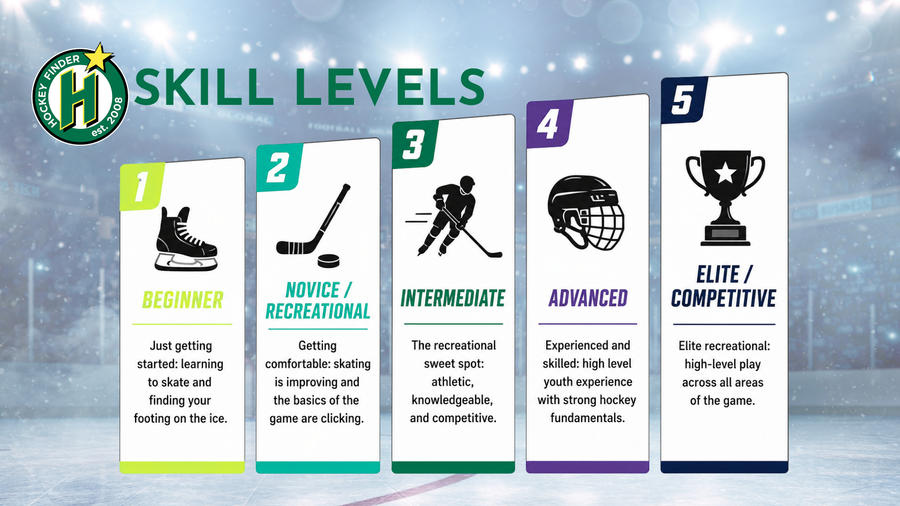
What Skill Level Am I? Hockey Finder's Guide to Adult Hockey Rankings
It's one of the first questions new players ask when they sign up for an adult hockey league: what skill level am I?
It sounds simple. But for many players — especially those returning to the game after a long break or those who learned in a different league system — it's actually one of the trickier parts of the registration process. Rank yourself too low, and you'll be bored, dominating games against players who are just learning to skate backward. Rank yourself too high, and you'll be in over your head, frustrated by the pace, and honestly making the experience worse for everyone around you.
At Hockey Finder, we've built a skill level system specifically designed for adult recreational players. It runs from Level 1 (complete beginners) to Level 6 (professional-caliber talent), with ratings that go beyond whole numbers. Players can rate themselves in increments of .1 or .2, meaning ratings of 1.7, 2.4, or 3.3 are completely valid. That precision matters. This guide walks you through every level, helps you assess yourself honestly, and explains why playing at the right level isn't just good for you; it's good for the whole league.
Why Honest Self-Assessment Matters More Than You Think
Hockey Finder's entire league model is built around parity. When teams are evenly matched, games are competitive, close, and fun. When they're not, you get blowouts — and blowouts are miserable for everyone, including the team winning 9–1.
The skill rating system only works if players are honest. Every player self-ranks when they first register, and those ratings are used to balance teams within each division. Team captains and division managers then verify rankings on a seasonal basis, and players who are significantly mis-ranked can be moved — or in some cases, removed from a division if there's no better fit available at that time.
The goal isn't to gatekeep or make anyone feel bad. The goal is to protect the experience for everyone on the ice.
So when you sit down to rank yourself, the most important thing you can do is be honest. Not modest. Not ambitious. Honest.
The Two Types of Mis-Ranking (And Why Both Ruin the Game)
The Sandbagger
A sandbagger is a player who ranks themselves lower than they actually are. Sometimes it's intentional — they want to dominate a lower division. Sometimes it's ego in disguise, the player who claims to be a Level 2 but skates and handles like a Level 4. Either way, the result is the same: they have an outsized advantage over the players they're lined up against, and the games become lopsided and unfair.
No one wants to play against a sandbagger. It takes the fun out of the game for the players who ranked themselves honestly, makes new players feel like they'll never improve, and undermines the entire competitive balance the league works hard to maintain. If you're thinking about registering at a lower level because you're worried the higher division will be too tough — don't. Play in the right division, get better, and earn your way up. That's how it's supposed to work.
The Try-Hard
The opposite problem is the player who registers at a level above their actual skill. Usually this comes from ego or optimism — they played D1 hockey in college ten years ago and figure they're still a 4.5. But ten years off the ice, a desk job, and a couple of injuries later, they may actually be a 3. When they play up, they struggle to keep up with the pace, create frustration for their teammates, and often compensate by playing overly physical or recklessly, which runs counter to Hockey Finder's Fun-Friendly-Social culture.
There's no shame in ranking yourself accurately. A player who knows they're a solid Level 3 and plays great Level 3 hockey is an asset to their team. A player who insists they're a 4.5 but can't skate edge-to-edge anymore is a liability — and a headache for everyone sharing the ice.
The bottom line: no one wants to play with sandbaggers or try-hards. Honest self-assessment isn't just a technicality. It's a basic act of respect for your teammates and opponents.
The Hockey Finder Skill Level Definitions
Hockey Finder ranks players on a scale of 1 to 6, with ratings precise to .1 or .2 increments — so a player might be a 2.3, a 3.7, or a 4.1. Ratings are based on an average of several factors: skating ability, stick handling, passing, shooting, hockey knowledge and experience, athleticism, and sportsmanship.
Levels 1-1.5: Finding Your Legs
Players at Levels 1-1.5 are still developing the most fundamental skating skills. Forward skating is coming along, but backward skating is still a challenge. Puck carrying, passing, and shooting are in early stages, and that’s completely fine — everyone starts somewhere. Players in this range may not be natural athletes, and that’s okay too. These are the levels to develop skills without pressure.
The physicality at this level should be essentially zero. Accidental contact happens because players are still mastering controlled movement, but intentional physical play has no place here.
If you’re still getting comfortable on skates or are graduating from an Instructional Program, divisions that start at Level 1.2 or 1.5 are a great place to start.
One thing that applies at every level, no exceptions: skate under control. For newer players and lower-level skaters especially, it's one of the most important habits to build early. You don't have to be fast — you have to be in control. That means knowing where your edges are, being able to stop when you need to, and not putting other players in a position to absorb your mistakes.
Levels 2-3: Getting Comfortable
Level 2 players have more experience on skates, though backward skating is still a work in progress. They’re starting to understand positional play, learning to skate with their head up, and picking up the basic rules and concepts of the game. Stick handling, passing, and shooting are improving but still developing.
By Level 2.5, backward skating becomes more natural and positional awareness strengthens. Players at this level understand zone concepts and team play but are still working on consistently executing technical skills — crossovers, edge work, sharp passes. Skating, stick handling, passing, and shooting are in the 3 to 4 out of 10 range.
Levels 2-3 are the heart of adult recreational hockey. Many adult players fall within this range. These skaters are generally athletic with solid hockey knowledge and decent skating and puck-handling skills. Many haven’t had significant coaching or played organized youth hockey, but they understand the game and can compete at a general recreational level. Some Level 2.5-3 players are experienced players who are slowing with age and have moved down from higher ranks.
Simply put, Level 2-3 players are average in most areas of the game. That’s not a knock — it’s the honest center of the adult rec spectrum, and there’s a ton of great hockey played here.
Levels 2–3 and 2.5–3.5: The Largest Buckets in Hockey Finder
If your game sits somewhere in that wide 2-to-3 range, you’re in very good company. The 2–3 and 2.5–3.5 skill buckets are by far the most populated divisions in Hockey Finder — and that’s not a coincidence. It reflects the reality of adult recreational hockey. Most players who come to the game as adults, or who played casually as kids and kept it going, land right here.
A 2.0 player is still working on the basics. A 3.5 player can skate confidently at pace, read the play, and compete in a fast recreational game. Those are genuinely different players, and the incremental rating system exists precisely for this reason. A player who rates themselves a 2.7 is telling the league something specific: I’m past the early beginner stage; I understand the game, but I’m still working on consistency and execution at speed.
Level 3-3.5 is for players who are comfortable in a fast-paced game and can keep up with the play. They’re in average physical shape, and their skating, stick handling, passing, and shooting are all in the 5 to 6 out of 10 range. If you played some youth hockey, especially in high school, are reasonably athletic, and understand the game well, Level 3 or 3.5 is likely your range.
Here’s a practical way to think about where you fall within this range:
- Around 2.0–2.2: You’re skating forward with growing confidence, still working on backward skating and stopping. You understand the basic flow of the game but are still learning positioning and puck control under pressure.
- Around 2.5–2.7: Backward skating is solid. You’re comfortable in your own zone, understand offensive and defensive positioning, and can make plays in open ice. Crossovers, edge work, and sharper passing are still works in progress.
- Around 2.8–3.0: You’re a solid recreational player. Skating is functional in all directions, your hockey sense is solid, and you can hold your own in a competitive rec game. You’re not a specialist in any one skill, but you’re competent across the board.
- Around 3.1–3.3: You play with noticeable hockey instinct. Your decisions are quicker, your skating is consistent, and you can execute in game situations without thinking too hard about the mechanics. You’re in the upper tier of the broad recreational middle.
- Around 3.4–3.5: You’re comfortable at pace, can keep up with faster-moving games, and bring a competitive edge to every shift. You’re approaching the 4-range and likely have a few specific skills — a strong shot, good edges, solid positional play — that stand out.
Because these divisions are so heavily populated, parity within them depends especially on accurate ratings. A 2.1 who rates themselves a 3.0 doesn’t just affect their own experience — they throw off the team balance for everyone else on their roster. The same goes for a 3.4 who plays down, thinking the lower competition will be easier. Both outcomes undermine what makes Hockey Finder work: close games, competitive shifts, and a league where everyone leaves the rink feeling like they played real hockey.
Levels 4 and 4.5: Serious Recreational Players
Level 4 players have substantial hockey abilities, skills, knowledge, and experience. Most Level 4s have been coached and have played considerable organized hockey in the past — youth leagues, high school, or adult leagues with higher competitive standards.
Level 4.5 players perform at a high level across all areas of the game. They understand the rules and team concepts deeply, are skilled at stick handling, passing, and puck control, and are in good physical shape. Skating, stick handling, passing, and shooting are in the 6 to 7 out of 10 range.
This is for players who played significant organized hockey and still have the skills to compete at a demanding recreational level. If you were a strong player at the D1 or C-level USA Hockey equivalent, Level 4 or 4.5 is likely where you belong.
Level 5: Elite Recreational
Level 5 players play at a high level across all areas: rules and team concepts, stick handling, passing, puck control, and skating. They’re in above-average physical shape, and their skating, stick handling, passing, and shooting are all in the 8 out of 10 range. This is for players with a strong competitive background — college hockey, advanced junior leagues, or similar. If you’re playing at this level, you know it.
Level 6: Professional
Level 6 players should be in a professional league. This is the top of the scale and applies to very few adult recreational players. If you’re genuinely a Level 6, Hockey Finder’s recreational leagues may not be the right fit — and honestly, you should probably be playing somewhere with higher-level competition.
How to Self-Assess Your Skill Level
The Hockey Finder skill rating is an average across multiple factors. Here's how to think through each one honestly:
- Skating: This is the foundation. Can you skate confidently in both directions? Can you stop reliably? Do you have edge control? Can you accelerate and change direction without losing your footing? Beginners struggle with backward skating and basic stops. Intermediate players are fluid in most situations. Advanced players can skate at full speed in tight spaces and execute crossovers without thinking.
- Stick Handling: Can you carry the puck at speed? Can you protect the puck under pressure? Can you make moves to get past defenders? Beginners often lose the puck while simply skating. Intermediate players handle it comfortably in open ice. Advanced players are dangerous with the puck in tight situations.
- Passing: Are your passes accurate and timed well? Can you receive passes cleanly? Can you make quick decisions to move the puck? Beginners are still developing accuracy. Intermediate players can execute basic plays. Advanced players make crisp, heads-up passes under pressure.
- Shooting: Can you generate meaningful power and accuracy on shots? Do you know when and how to shoot? Beginners are still learning basic mechanics. Intermediate players can take serviceable shots from the slot. Advanced players have quick releases and can pick spots.
- Hockey Knowledge: Do you understand zone play, offside, icing, line changes, and positioning? Beginners are learning the rules. Intermediate players understand the game. Advanced players make smart decisions quickly because the game makes intuitive sense to them.
- Athleticism and Physical Conditioning: Recreational hockey is a demanding sport. Where do you fall on the overall fitness and athleticism spectrum? Being honest here matters — a player who's highly skilled but in poor shape may belong in a lower division than their technical skills suggest.
Once you've thought through each of these, average them. If you're a 5 on skating but a 2 on stick handling and a 3 on hockey knowledge, you're probably a 3 — not a 4.5. The skill level is a composite, not a highlight reel.
How Hockey Finder Compares to Other League Systems
If you've played in other adult leagues, you may already have a USA Hockey letter designation or a rating from another organization. Here's how Hockey Finder's levels map to some common systems:
Hockey Finder | USA Hockey | AHA | WHAM | OMCHL | Des Moines |
1 / 1.5 | Beginner | Beginner / D2 | C3 / C2 | Novice | WAHL Novice |
2 / 2.5 | D3 / D2 | D1 / C3 | C1 / B3 | Novice / INT B | CIDL D2 / D1 |
3 / 3.5 | D1 / C3 | C2 / C1 | B3 / B2 | INT B / INT A | Metro D / Bucs C |
4 / 4.5 | C2 / C1 | B3 / B2 | B1 / A2 | INT A / MCHL | High C / DSM B |
5 | B2 | B1 | A2 | MCHL | DSM B/A |
6 | NHL | NHL | PWHL | NHL | NHL |
These comparisons are general guidelines — not every league measures the same way. Use them as a reference point, not a hard conversion.
What Happens If Your Ranking Is Wrong?
Hockey Finder's division managers review player rankings each season. If your actual play doesn't match your registered level, you may be:
- Moved to a more appropriate division
- Refunded if no appropriate division is available
This isn't a punishment — it's the system working as intended. But it's also avoidable. Self-ranking honestly from the start is faster, easier, and better for everyone.
It's also worth noting: players who register at the wrong level don't just inconvenience the league staff. They affect every game they play. The team that was supposed to have balanced competition instead faces a mismatch, and those players — who signed up and paid to play competitive recreational hockey — deserve better.
One More Thing: Sportsmanship Is Non-Negotiable
Hockey Finder's skill ratings don't just measure physical ability. Sportsmanship is part of the equation — and it's explicitly called out in the league guidelines. No matter the skill level, over-aggressive play will not be tolerated.
The Fun-Friendly-Social culture is mandatory. That means playing hard but clean. Competing with intensity but not with a chip on your shoulder. Helping newer players develop instead of running them over. Enjoying the game the way adult recreational hockey is meant to be enjoyed — with your teammates, your opponents, and your friends on the other team at the bar afterward.
If your competitive instincts push you toward physicality or frustration when things don't go your way, take a step back. You're here to have fun. So is everyone else.
Ready to Register? Here's How to Find Your Level
When you register with Hockey Finder, you'll go through the self-ranking process using the guidelines on our skill level definitions page. Take your time with it. Watch the reference videos for each level. Use the Skill Calculator. Ask a hockey-playing friend who will give you an honest answer.
Then commit to your ranking — not the one that makes you feel best about yourself, but the one that actually describes how you play today. The league experience you get on the other side will be better for it.
Ready to find your division? Visit hockeyfinder.com/register to get started. And check out the full skill level definitions at hockeyfinder.com/hockey-skill-level-definitions.
Frequently Asked Questions
What if I'm between two levels?
Hockey Finder's rating scale is more granular than whole- or half-number ratings. Players can rate themselves — and be rated — in increments of .1 or .2, so ratings like 1.7, 2.1, 2.4, or 3.3 are all valid. If you feel like you're solidly past a whole number but not quite at the .5 mark, a .1 or .2 gets you there. If you're closer to the next half-step, try .3 or .4. The goal is precision — the more accurately your rating reflects your actual play, the better the league can balance teams and place you in the right division.
Is there anything that applies at every skill level?
No matter your skill level, skating under control is always expected. This is especially important at the lower levels, where unpredictable movement and loss of edge control are the most common causes of accidental contact. The rink is a shared space — controlling your speed and body position protects you and everyone around you.
What if I haven't played in years?
Rust is real. A player who was a solid Level 4 ten years ago and has barely skated since is probably a 2.5 or 3 today. Be honest about where you are now, not where you were. However, You’re probably better than you think you are. You can always move up as your skills come back.
Can I play in a lower division than my skill level?
No. Playing below your skill level — sandbagging — is exactly what the ranking system is designed to prevent. It creates an unfair advantage and ruins the experience for other players. Even if you think you can “play down.” Register at your actual, most accurate level.
What if I get placed in the wrong division?
Reach out to Hockey Finder's division managers. They review rankings seasonally and can work with you to find the right fit. The goal is to get you in the right place — not to leave you stuck somewhere that isn't working.
Does this apply to pickup hockey too?
Yes. Hockey Finder's pickup games are also open to players of all skill levels, and the same principles apply. Higher-level players are encouraged to be inclusive and supportive of lower-level players in those settings — not to dominate, but to make the game better for everyone.
From the NHL to adult rec, every hockey league plays by different rules. Compare the NHL, PWHL, NCAA, USHL, QMJHL, and USA Hockey youth and adult divisions here.
This is the most comprehensive ice hockey glossary you'll find anywhere — built for players, coaches, fans, and everyone in between. Learn hockey lingo today.